

Big group of people, a countdown clock, and one poor soul trying to remember how to write a for loop.
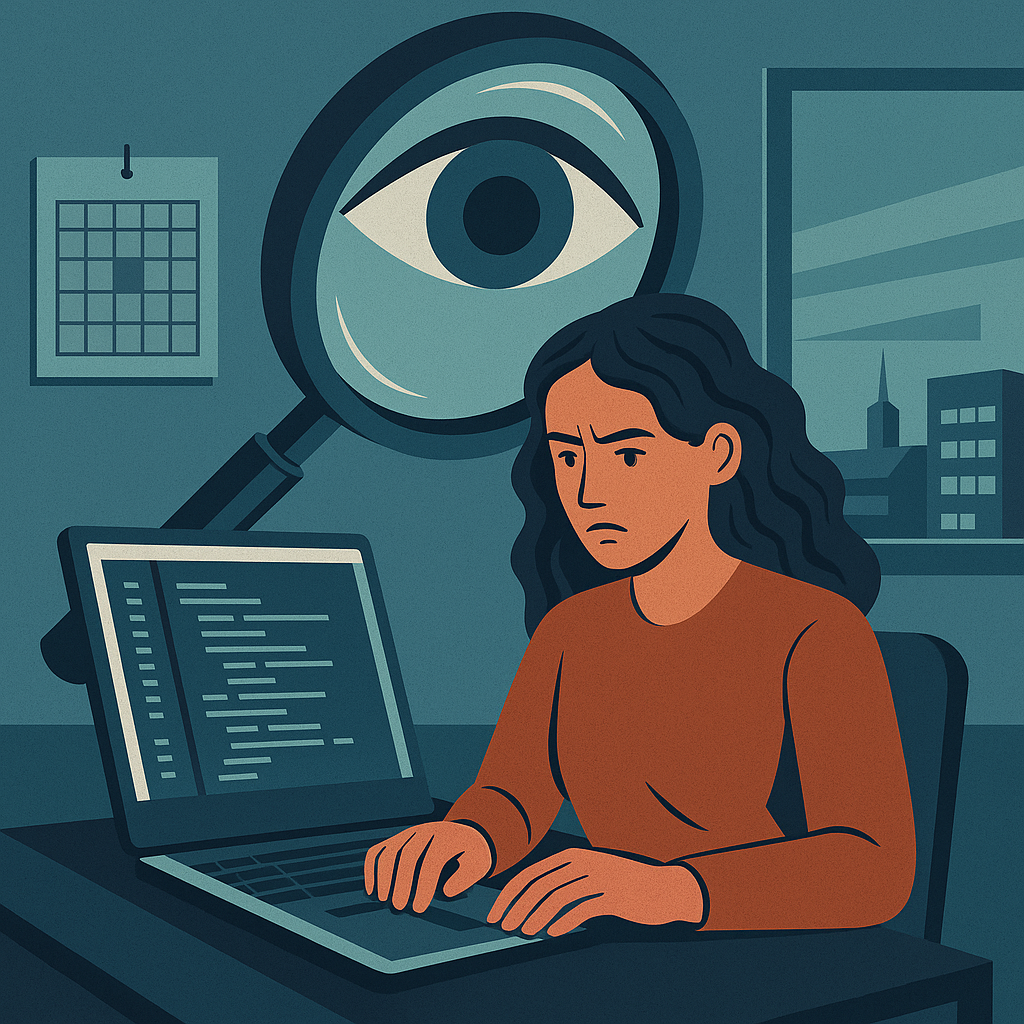
Live coding interviews are a common way to assess IT engineers.
You’re given some algorithmic problem, and someone — sometimes just one person, but more often a whole group — is watching you solve it in real time, while you share your screen. And the whole time, it feels like they’re all looking at you through a magnifying glass. Sometimes the interview happens in total silence. Other times, they’re casually sipping coffee and saying, “Take your time,” as if that magically makes it less horrifying.
Because, how else would you know if someone can code unless you watch them do it live, right?
But what if I told you that if you’re someone who needs more time to thinkand evaluate — or if you’re neurodivergent — chances are this format feels completely disconnected from how your brain actually works?
And you’d be right.
My Story
I was once told by HR that I’d be having a friendly conversation with two managers about a potential project. It should be just a casual talk with no pressure.
When the meeting started, not just only to two — but whole group of five men joined the call. And instead of a friendly talk about the project, they jumped straight into testing my programming skills, even though I had applied for a QA/test automation role.
Which is… well… not exactly programming. It’s more like scripting. Or let’s be honest — mostly about trying to find the right XPath.
I never quite understood why they needed to show up in such a big group. Maybe they thought I was about to launch a rocket instead of just talk about test automation. To make sense of it somehow, I just told myself, “Well… I guess I’m too much to handle.”
They asked me to write code live while sharing my screen. With no prior preparation and no warning. But for me this is the same thing as if you’ve told me to go on a stage without script.
It was the worst interviews of my life.
Later, they emailed me to ask if I’d be open to a home assignment. I declined — by then, I knew I didn’t want to work for this company or with these people. Eventually, one of the managers called me personally to apologize for how it was handled.
Well… what can I say? I made an impression.
I don’t remember much of the technical questions. I just remember the unfairness of the whole situation, the PTSD I still have after this meeting and the feeling of being automatically set up to fail.
While being INFJ doesn’t necessarily mean I’m neurodivergent, I’ve often found myself navigating similar barriers — especially in high-pressure interviews built for fast talkers and extroverted minds with predominant Se (Extraverted Sensing — quick, action-focused) and Te (Extraverted Thinking — efficiency- and results-driven).
I don’t claim to speak for the neurodiverse community, but I do recognize the overlap. The setup that overwhelms autistic or ADHD candidates overwhelms me too. And I know I’m not the only one.
The Setup Isn’t Neutral
Live coding is often seen as a neutral skill test. But it’s not. It favors a very specific kind of cognitive style: people who can think out loud, recall syntax on the fly, stay calm under pressure, and perform well while being silently observed. From an MBTI perspective, that often means extroverted, fast-thinking types like ENTP, ESTP, ENTJ, and even INTP -people who don’t mind improvising in real time or being in the spotlight.
But for more reflective types like INFJ or ISFJ, who need time, context, and internal clarity before acting, this setup can feel completely unnatural.
That’s not everyone — and certainly not every talented engineer.
And then there’s another layer: neurodivergent minds.
If you’re autistic, ADHD, dyslexic, or otherwise neurodivergent, your brain might thrive in a deep-focus state, in longer sprints, or in async environments. But live coding compresses time and adds performance pressure — stripping away the conditions that usually support your best work.
Pressure ≠ Competence
I see myself as a very good engineer. But during live coding interviews, I freeze— not because I don’t know the answer, but because I can’t always find it under pressure, in a limited time, and in an environment that makes me uncomfortable. My brain just blanks. I need time to think — without someone staring at me.
What’s wild is that we’d never design software like this. We don’t build in a rush, because nowadays, we use AI, we google things, we check Stack Overflow.
We write, delete, rewrite. We go for a walk in a nature and then we come back with a brilliant idea. That’s how real code gets made. So why are we pretending that this fake “stage” is the best measure of engineering ability?
Neurodivergent ≠ Broken
There’s a myth that if you can’t do live coding, you’re somehow not good enough. But what if the format itself is broken — for anyone who doesn’t fit the neurotypical mind?
People with ADHD might struggle with shifting focus. People with autism might find the unspoken social dynamics draining. And honestly-some of us just think better when we’re not being stared at like animals in a zoo, expected to put on a performance. Or like a contestants on a TV reality show.
And that’s okay.
What Would Be Better?
If we really wanted to see what someone can do, we’d offer:
- Take-home challenges with generous time limits
- Genuine conversations with colleagues or managers about past projects, achievements, and ideas for improvement
- Open-book sessions where you can tools which you normally use (Yes, I’m talking about AI)
Not everyone needs to be tested like it’s a game show.
Let’s Stop Mistaking Speed for Skill
I’m not saying we should eliminate live coding altogether. Some people genuinely like it. But we should stop treating it as the default — or worse, the one and only option how to spot a good engineer.
Neurodivergent minds bring deep focus, unique pattern recognition, creative problem-solving, and unconventional approaches. But only if you give them the right environment to show up fully.
Live coding often isn’t that environment.
And companies that rely solely on live coding are missing out on engineers who think differently — people who could lead them in directions they didn’t even know existed. With out-of-the-box ideas that take time to fully unfold.
So if you’ve ever bombed a live coding interview and walked away thinking “I’m not good enough,” I just want to say:
You are enough, but the system wasn’t built for you.
~ Andrea